
The fourth Estonian-Latvian power connection
In October 2023, the Estonian electricity transmission system operator Elering submitted an application to the Ministry of Regional Development and Agriculture to initiate a designated national spatial plan. The spatial plan will determine whether and how it would be expedient to build the Estonian part of the fourth Estonian-Latvian power connection from Paide through Muhu to the Sõrve peninsula in Saaremaa.
Overview of the onshore section of the interconnection
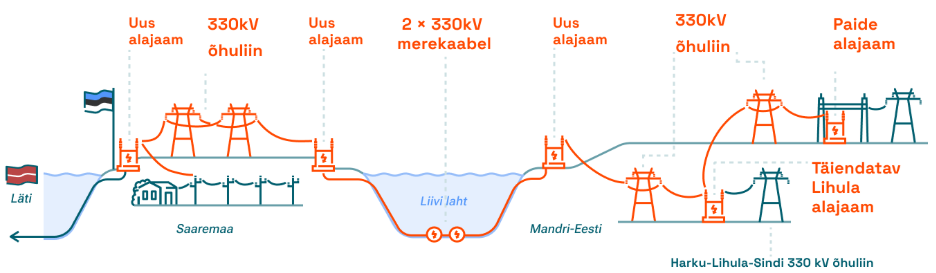
The new connection would start from the Paide substation in Central Estonia. New 330 kilovolt lines should be built from Paide to Virtsu via Lihula. There, the lines should reach the west coast of Saaremaa, where the submarine cable to Latvia would begin. The route of the submarine cable between Estonia and Latvia will be selected with a building permit separate from the planning process.
A designated national spatial plan is prepared for the construction of a building with a significant spatial impact, the location or operation of which is of great national or international interest. Before building a new power connection, its benefits to society are studied. In addition to technical works, the impact on nature and local people must also be assessed. Construction will only begin when it is clear that this connection is necessary for our region at large. It can take about a decade to establish interstate power connections.
Why is it necessary to establish a fourth interconnection between Estonia and Latvia?
The owner of Elering, the Minister of Climate, has issued guidelines to identify the possibilities of establishing a new connection through Saaremaa. The connection to be established will increase security of supply and create opportunities for receiving a larger amount of renewable energy into the Western Estonian network, contributing to achieving the country’s goals of climate neutrality.
Where and what is being built?
In order to develop the fourth Estonia–Latvia electricity interconnection, in addition to the new lines located on the islands, it is also necessary to identify a transmission corridor for a new 330 kV overhead line between Paide and Lihula, which will ensure security of supply within the mainland 330 kV network.
The electricity connection is planned to consist predominantly of 330 kV overhead lines on land. In locations where overhead lines cannot be implemented, underground cables are planned. In marine areas, submarine cables will be installed. It is also necessary to plan substations. The exact locations of substations and the transmission line corridor alignments are being determined through a national spatial planning process. The proposed planning area has been defined sufficiently large to allow the selection of the best possible option among different alternatives. All interested parties will be able to participate in the planning process, which will be announced by the Ministry of Economic Affairs and Communications after the initiation of the plan.
Indicative project timeline
The planning of a new electricity interconnection takes several years. Before technical works can begin, the most suitable route for the transmission line is identified and its impacts on nature, local communities, and society are assessed through a national spatial planning process. If suitable corridors are found and the construction of the connection is deemed economically viable, further steps include detailed design, the permitting process, and the conclusion of land-use agreements with all landowners before construction can begin. Physical construction works will not start before the next decade. The interconnection is planned to be completed in the second half of the 2030s.
Project financing
If the construction of the fourth Estonia–Latvia electricity interconnection is economically viable, Elering will apply for European Union funding so that the construction costs do not affect the network tariffs paid by consumers. The European Commission has included the fourth Estonia–Latvia project in the list of Projects of Common Interest, which creates the preconditions for obtaining European Union funding.
Can and how can I have a say in the process?
Anyone interested can participate in the planning process. The information and proposals collected during the planning process will be made public and public discussions will take place. The Ministry of Economic Affairs and Communications will provide more detailed information about the opportunities for participation after the designated national spatial plan has been initiated.
Offshore section of the interconnection
On 8 May 2024, Elering submitted a building permit application to the Consumer Protection and Technical Regulatory Authority (TTJA) for the construction of the marine cable of the fourth electricity interconnection between Estonia and Latvia. The new interconnection will significantly increase electricity transmission capacity between Estonia and Latvia and help strengthen security of supply.

Initiation of the Building Permit Procedure
On 23 December 2024, the Consumer Protection and Technical Regulatory Authority (TTJA) initiated the building permit procedure, including an Environmental Impact Assessment (EIA) process, by decision No. 1-7/24-422. The assessment will also cover potential transboundary impacts. The EIA is mandatory because the planned activities may have significant environmental effects, including extensive seabed dredging and potential impacts on the conservation objectives of Natura 2000 sites.
Read more (in Estonian)
